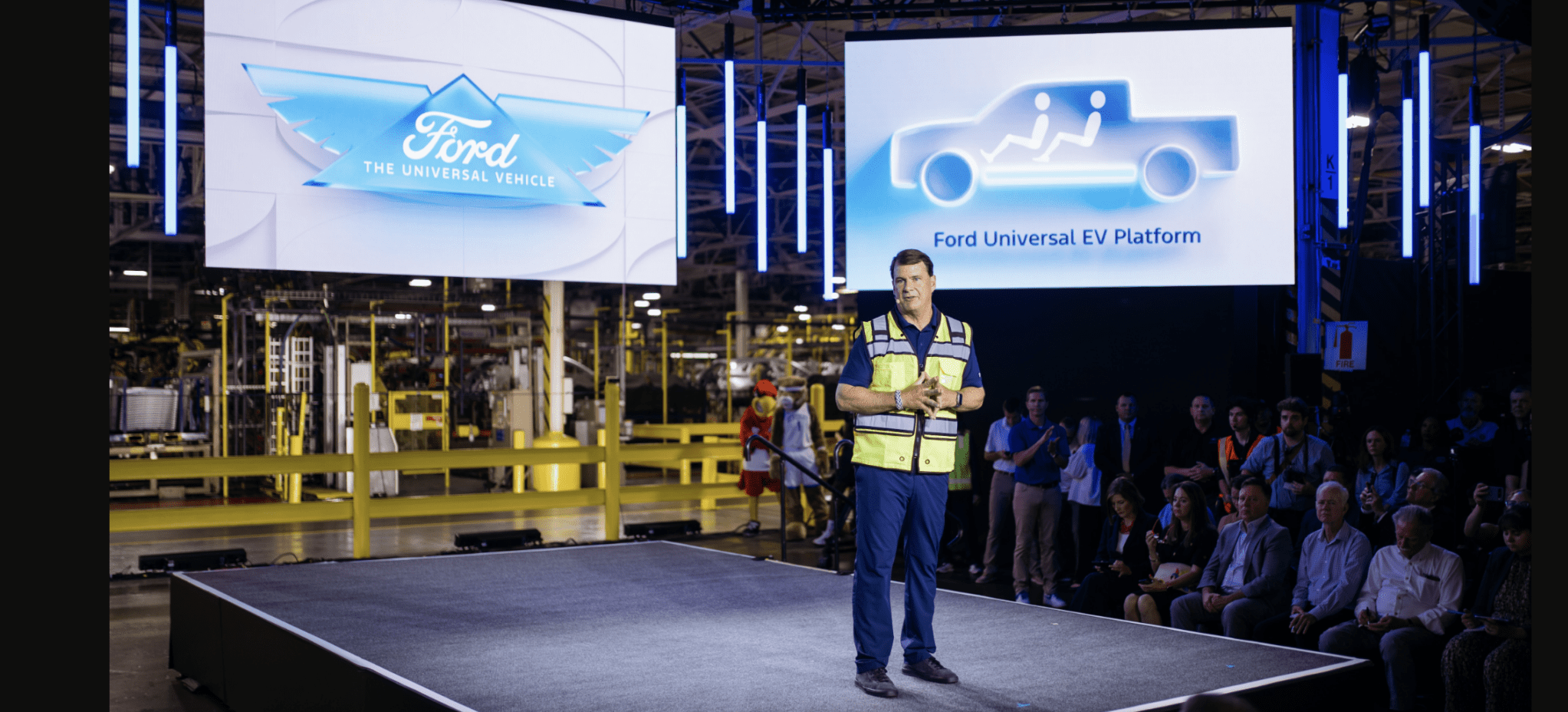
Farley warns Chinese rivals could enter US within a decade
Ford Chief Executive Jim Farley told employees in a 30 July town hall that the automaker is preparing for the possibility of Chinese automakers entering the US market within the next five to ten years, with entry more likely toward the later end of that range, people who viewed the meeting have told Reuters. The comments arrive as the US Senate pushes to expand its ban on Chinese market access, and mark the most specific public timeline yet from a Detroit executive that has oscillated wildly in his commentary on China-based automakers.
The US currently blocks the sale of Chinese-made electric vehicles (EVs) through insurmountable tariffs of roughly 100%. On top of this are Commerce Department rules banning Chinese connected-vehicle software by model year 2027 and hardware by 2030, adopted under President Biden and subsequently retained by the Trump administration.
Chinese automakers have nonetheless gained meaningful share in Mexico—despite recently-imposed import tariffs of 50%—and can sell limited EV volumes into Canada under a quota introduced early in 2026. Due to the high similarity between US and Canadian markets, analysts are now broadly treating Canada as the leading indicator for how quickly US demand for affordable Chinese EVs would convert into actual sales if given the chance.
As legacy automakers go, few are more audibly dialled-in to the threat from China than Ford. The automaker’s Executive Chair, Bill Ford, said earlier in July: “We have to go toe-to-toe with China […] we can’t expect to keep them out forever.” Meanwhile, Ford is separately preparing to launch a family of ground-up affordable EVs engineered to match Chinese cost structures through simplified architecture and parts reduction.
The first of this product, a pick-up truck estimated to retail starting at just US$30,000, is expected to launch in 2027. Notably the new vehicles will use technology derived from Chinese battery giant CATL, licenced out to Ford for domestic production. The automaker had repeatedly framed Chinese pressure as forcing every automaker to get “leaner and smarter”—and in many cases, Ford has accepted that this means working directly with the competition.
Indeed, this is far from the first time Farley has sounded an alarm on China only to be found working closely with the same rivals shortly afterward. In February, Ford and Xiaomi both emphatically denied Financial Times reporting that the two firms had discussed a US joint venture, dismissing the claim as “completely false”. Yet Farley has a well-documented history of open admiration for the very company involved, having personally imported and driven a Xiaomi SU7 for months, and offered on multiple occasions some strikingly effusive commentary. To him, Xiaomi is the “the Apple of China” and its cars are “far superior” to Western equivalents.
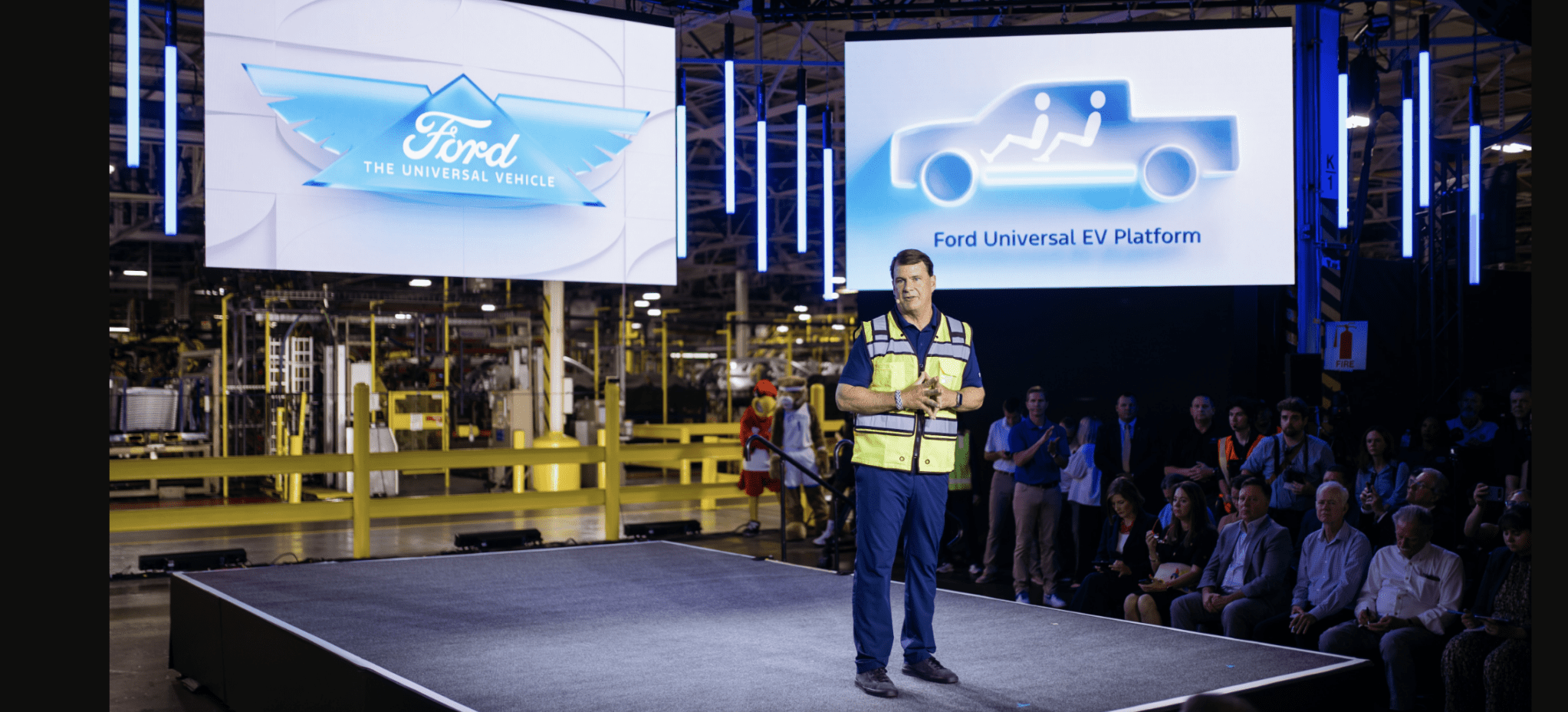
Ford has characterised its new Universal EV platform as a “model T moment” and a mechanism to match China on cost
Mere days after that denial, Bloomberg reported Farley was separately discussing with Trump administration officials a framework that would let Chinese automakers build in the US through joint ventures requiring majority American ownership, a structure that mirrors what China itself demanded of Western carmakers decades ago. General Motors publicly opposed the idea outright, while Ford’s own spokesperson insisted the company’s actual position was protecting the US market from “a flood of subsidised vehicles built in China”.
The pattern repeats geographically rather than resolving. Ford confirmed in July that it will hand part of its underused Almussafes plant in Spain to Geely, letting the Chinese automaker dodge EU tariffs and reach the European market years faster than a new factory would allow. The arrangement drew criticism from some US lawmakers, on whose soil the deal did not occur, even as it directly answers the same competitive pressure Farley has spent two years calling existential.
The cumulative effect of Ford and Farley’s oscillating remarks and actions regarding China is less a coherent strategy, and more a company hedging in every direction it can reach simultaneously. Partnering with Chinese OEMs where doing so inescapably relieves cost or capacity pressure, publicly resisting their entry where doing so protects home-market share, warning employees about a threat whose timeline keeps sharpening generates urgency. Denying specific partnerships, whose logic Farley has already made obvious in his own interviews, has an unsurprisingly limited effect.
Attaching a five-to-ten year window to Chinese entry signals Ford is now treating US market entry as a planning assumption behind its cost and product roadmaps rather than a distant hypothetical. Clearly, it has little confidence in the long-term durability of existing US trade blockades on Chinese-made EVs. Extensive social media campaigns are already being run on US social media, quite successfully, to create an aura of unattainability around these vehicles.
Whether that reflects genuine foresight, or simply gives Farley cover to keep deepening Ford’s own Chinese partnerships will remain opaque for some time. The success of Chinese automakers in breaking into the Canadian market should offer the first meaningful indicator as to how prescient Farley’s predictions actually are.
AP by OMG
Asian-Promotions.com |
Buy More, Pay Less | Anywhere in Asia
Shop Smarter on AP Today | FREE Product Samples, Latest
Discounts, Deals, Coupon Codes & Promotions | Direct Brand Updates every
second | Every Shopper’s Dream!
Asian-Promotions.com or AP lets you buy more and pay less
anywhere in Asia. Shop Smarter on AP Today. Sign-up for FREE Product Samples,
Latest Discounts, Deals, Coupon Codes & Promotions. With Direct Brand
Updates every second, AP is Every Shopper’s Dream come true! Stretch your
dollar now with AP. Start saving today!
Originally posted on: https://www.automotiveworld.com/news/farley-warns-chinese-rivals-could-enter-us-within-a-decade/