
EPA filing reveals Tesla Cybercab’s full specifications
EPA certification filings have revealed the full technical specifications of the Tesla Cybercab for the first time: a 163 kW (219 hp) front-mounted permanent magnet motor, a 48 kWh lithium-ion battery pack running at 326 V, and a kerb weight of 1,412 kg—making it the lightest electric vehicle in the US. The unadjusted combined EPA range of 418.2 miles translates to approximately 293 miles under the standard 0.7 adjustment factor, aligning with Tesla’s earlier claim of “close to 300 miles”.
The filing lists the introduction into commerce date as 29 May 2026, confirming the production ramp at Giga Texas is underway. The specifications carry some notable engineering choices, perhaps most notably the switch to front-wheel drive. Every other model in Tesla’s lineup uses rear- or all-wheel drive, reflecting a packaging and cost decision rather than a performance one. The choice effectively eliminates the rear subframe and driveshaft in a vehicle that does not need sporting dynamics. Indeed, little of what might be considered appealing in terms of the driving experience needs to be carried forward into the Cybercab, which entirely lacks manual controls.
The motor is deliberately oversized relative to the Cybercab’s performance targets: a 219 hp unit in a sub-1,500kg vehicle is not there for acceleration, but to allow the motor to operate in its most efficient torque band during the low-speed urban cycling that defines its use case. The result is the most energy-efficient Tesla driving experience to date at 165 Wh/mi.
The 1,412 kg kerb weight is the arguably the most surprising figure in the filing; for a purpose-built two-seat vehicle with no steering wheel, no pedals and a battery pack roughly 12 kWh smaller than a Model 3’s, it is heavier than the architecture suggests it should be. Much of this will be due to the 48 kWh battery; the autonomous driving hardware—cameras, compute modules, wiring—will also account for some of the excess, as will the reinforced crash structures required at the front of a vehicle with no steering column to absorb impact energy.
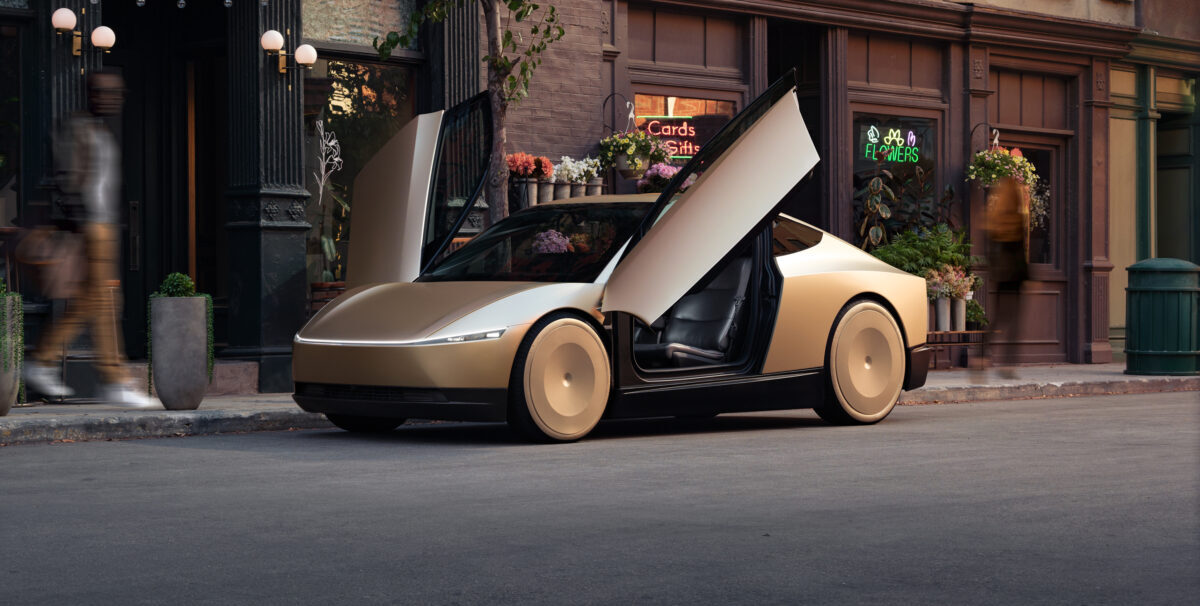
Tesla has warned that ramping production of the Cybercab will be “agonisingly slow”
It should be noted that the vehicle’s payload is quite small; the gross vehicle weight rating comes in at 1,692 kg, leaving just 280 kg for passengers and their belongings. This is enough for two people of average weight and a modest amount of luggage, but with limited margin for variation. For a robotaxi operating commercial cycles, payload headroom matters operationally: it constrains the range of passengers and luggage combinations the vehicle can legally carry and potentially affects insurance classifications in some jurisdictions.
The certification filing is consequential but also deeply incomplete in the context of Tesla’s autonomous ambitions. The Cybercab is now EPA-certified, cleared for US roads from an emissions standpoint and technically introduced into commerce, but it does not have regulatory approval for autonomous operation in a single jurisdiction.
Tesla’s planned “Unboxed” manufacturing system, which assembles modular sections of the vehicle separately before combining them, has not been confirmed as operational; Chief Executive Elon Musk warned earlier this year that production under the new system would be “agonisingly slow” as Tesla adapts to the novel approach. The launch timeline remains “before 2027”. It is highly possible that the vehicle slips into next year, if not outright inevitable; a long history of missed self-driving deadlines and deep uncertainty over regulatory clearances continue to hang over real-world commercial deployment.
While Tesla continues working to bring the Cybercab to market proper, other players continue to advance at relatively greater speeds. Perhaps none more so than Waymo, which is operating commercially across multiple US cities with a mature, LiDAR-equipped system, with overseas deployments in London and Tokyo also planned for 2026. Meanwhile, Zoox is advancing its purpose-built robotaxi, and Amazon and Uber have both committed capital to the sector.
Tesla’s camera vision-only approach—no LiDAR, no radar, no HD maps, end-to-end neural network—remains unproven and perceived with broad scepticism from the wider autonomous driving sector. But if it works at scale, it could also prove far cheaper to deploy than sensor-heavy competitors. The statistical reliability level required for commercial unsupervised operation is the only number that truly matters, and the EPA filings do not contain it.
AP by OMG
Asian-Promotions.com |
Buy More, Pay Less | Anywhere in Asia
Shop Smarter on AP Today | FREE Product Samples, Latest
Discounts, Deals, Coupon Codes & Promotions | Direct Brand Updates every
second | Every Shopper’s Dream!
Asian-Promotions.com or AP lets you buy more and pay less
anywhere in Asia. Shop Smarter on AP Today. Sign-up for FREE Product Samples,
Latest Discounts, Deals, Coupon Codes & Promotions. With Direct Brand
Updates every second, AP is Every Shopper’s Dream come true! Stretch your
dollar now with AP. Start saving today!
Originally posted on: https://www.automotiveworld.com/news/epa-filing-reveals-tesla-cybercabs-full-specifications/