Europe’s truckmakers insist battery swap not needed
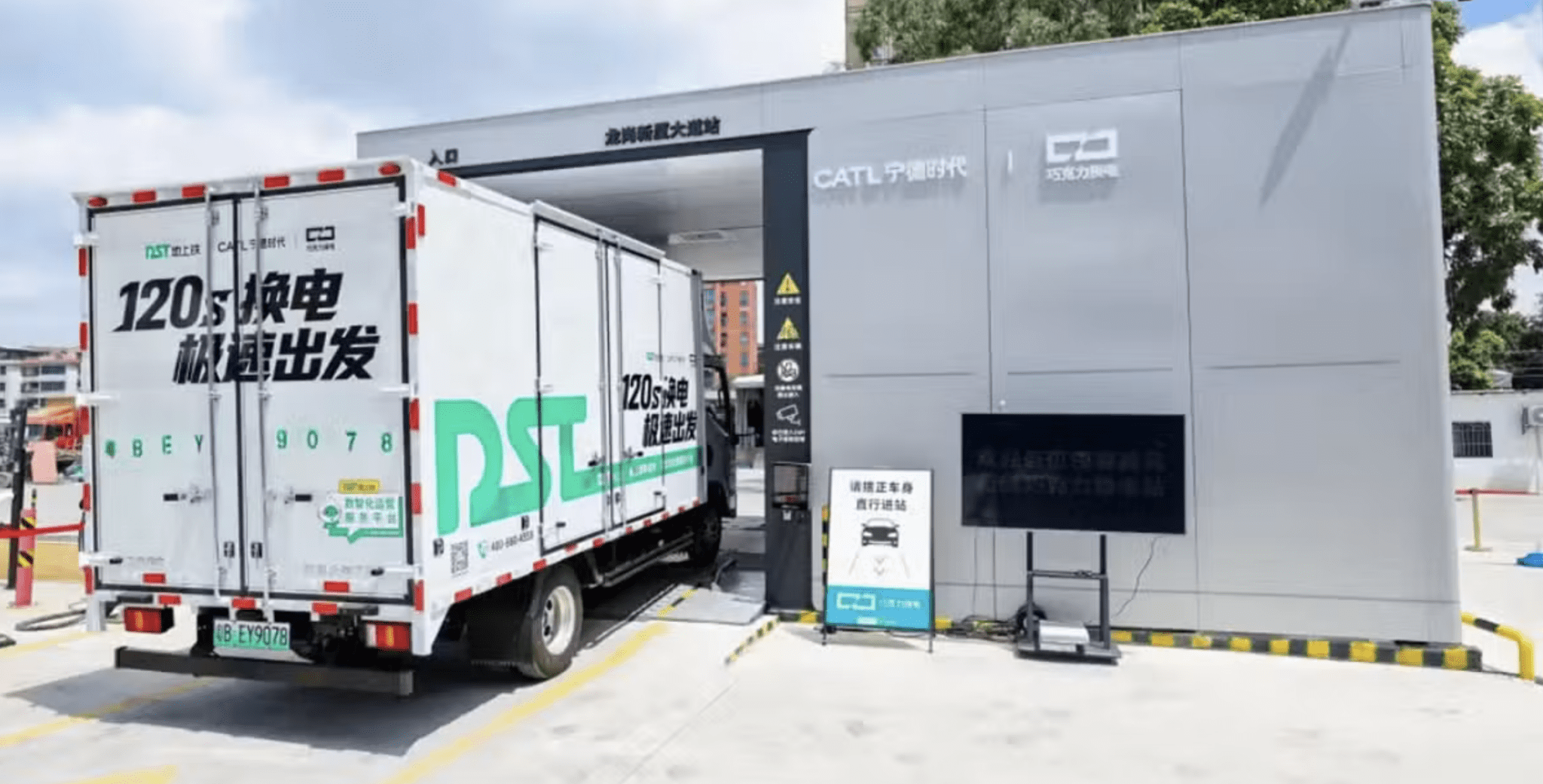
European truckmakers are pushing back against a CATL-Octopus joint venture to build a battery-swapping network for heavy-duty trucks, raising concerns about standardisation, OEM autonomy and the strategic implications of adopting a Chinese-led infrastructure model, according to a report by Nikkei. The venture, branded Swaptopus, plans 30 stations across Europe by 2035, with its first UK hubs launching in 2027.
The resistance centres on just how much it would take to make a swapping system work. European truckmakers would need to be uncommonly open: sharing technologies and harmonising their vehicle design, battery architecture, hardware interfaces, software, and battery management and communications protocols across competing brands. Sun Jie, Research Analyst at S&P Global Mobility, framed it in blunt terms to Nikkei: “European OEMs may be reluctant to adopt a CATL-led standard that limits their control and differentiation.”
A broad consensus formed along these lines among the analysts to whom Nikkei spoke. Thomas Fabian, Chief Commercial Vehicles Officer at the European Automobile Manufacturers’ Association (ACEA), argued the priority should be accelerating open, interoperable solutions that enable cross-border transport, not locking fleets into a proprietary swap standard. Meanwhile David Cebon, Director of the Centre for Sustainable Road Freight at the University of Cambridge, warned that Volvo, Scania, Mercedes-Benz, MAN and DAF would “fight to the death” rather than cede their battery intellectual property or submit to a shared CATL architecture.
These concerns are not abstractions but rooted in basic commercial reality: fleet operators under a swapping model would have to lease rather than own their batteries, and this removes a layer of OEM differentiation and transfers a degree of commercial leverage to whoever controls the swap standard. In this case, that would be a Chinese battery maker during a period where geopolitical disruptions are already sowing discord across all major automotive markets.
The pushback is happening against a backdrop of sustained announcements from European truck makers that appear, whether intentionally or otherwise, to argue the existing electrification approach is working. Renault Trucks has extended the E-Tech T’s maximum range to 660 km and says operational data from 70,000 connected European tractors shows 80% of real-world long-haul missions are already covered within this range, rising to 90% when the legally mandatory 45-minute driver break every 4.5 hours is used for a fast charge.
Meanwhile, Mercedes-Benz Trucks has published data from more than 3,000 analysed tours confirming daily long-haul viability in its own eActros network, and MAN Truck & Bus has demonstrated a stable 3,000-ampere charging current in the NEFTON research project, pointing toward three-megawatt charging that could restore 400 km of range in as little as ten minutes. This, in theory, could cancel out the downtime concerns entirely.
For CATL and Octopus, of course, the commercial logic rests entirely on the dual arguments of reduced downtime and lower total cost of ownership. Battery swapping compresses a stop to roughly the duration of refuelling diesel, and the lease model removes the battery from the truck’s upfront cost entirely. The latter of these is arguably the single most onerous barrier still facing fleet conversion, and it is telling that in China, where swap networks are substantially more common—if not ubiquitous—that adoption rates are markedly higher. Specifically, 29% for new energy trucks in China during 2025, against 0.9% in the UK and 4.4% in Europe during Q1 2026. Battery-swapping, while more expensive than standard charging, is also cheaper than diesel refuelling.
CATL brings a proven model to the table: it operates more than 300 heavy-truck swap stations in China serving 12 truckmakers across 16 models, and plans 900 by the end of 2026 covering 80% of core domestic logistics routes. Octopus provides the local expertise, grid relationships, planning access and policy credibility that direct Chinese industrial entry into Europe would struggle to secure under current scrutiny.
Neither partner, however, has demonstrated the European OEM alignment which is essential for swapping to reach any kind of viable scale. Analysts quoted by Nikkei noted that the EU’s Megawatt Charging Standard, which entered service from February 2025, already allows a truck battery to charge from 20% to 80% in 30 to 40 minutes—fitting inside the mandatory driver rest break period. Scania and its partners are targeting 1,700 MCS charging points by 2027.
The charging model, according to the emerging European consensus, is not perfect but sufficiently good, open and in-motion to foreclose the need for a CATL-designed alternative. Whether the aptly-named ‘Swaptopus’ venture ultimately proves viable may be less a question of technology than timing: CATL and Octopus are arriving with a compelling answer to a problem that European truckmakers are working hard to insist is already solved.
AP by OMG
Asian-Promotions.com |
Buy More, Pay Less | Anywhere in Asia
Shop Smarter on AP Today | FREE Product Samples, Latest
Discounts, Deals, Coupon Codes & Promotions | Direct Brand Updates every
second | Every Shopper’s Dream!
Asian-Promotions.com or AP lets you buy more and pay less
anywhere in Asia. Shop Smarter on AP Today. Sign-up for FREE Product Samples,
Latest Discounts, Deals, Coupon Codes & Promotions. With Direct Brand
Updates every second, AP is Every Shopper’s Dream come true! Stretch your
dollar now with AP. Start saving today!
Originally posted on: https://www.automotiveworld.com/news/europes-truckmakers-insist-battery-swap-not-needed/