Tesla puts Terafab in Texas for US$16bn, but plan still vague
Tesla and SpaceX have confirmed that Terafab, their jointly planned semiconductor megafactory, will be built in Grimes County, Texas, with an initial phase costing roughly US$16.8bn. The companies describe the finished site, which will span more than 100 million square feet, as the largest chip manufacturing facility on the planet, intended to produce chips for Tesla’s future product lineup including Cybercab and the Optimus robot, as well as SpaceX’s planned space-based data centres.
The investment figure attached to Terafab has changed more than once since Chief Executive Elon Musk first unveiled the project in March, when the headline number was US$25bn. A SpaceX filing in May floated an initial US$55bn investment rising to US$119bn across a multi-phase build. That same filing described Terafab as only a “general framework” with no binding commitments, no finalised intellectual property split, and no obligation for either company to keep participating.
The confirmed US$16.8bn figure is the first hard capital commitment attached to any of those numbers, and it is also the lowest of the three. Despite some local concerns about a lack of transparency and the impact on local water and energy resources, tax abatement agreements are now signed and SpaceX has made its first US$10m payment to the county.
Much of the actual manufacturing will not come from Tesla or SpaceX at all. Intel joined the project in April to handle design, fabrication and packaging; Tesla has never produced a semiconductor wafer, while Intel has been doing so for decades using process technology that ranks among the most sophisticated in volume production today. The project is a lifeline for Intel Foundry—which lost US$10.32bn in 2025 on revenue growth of just 3%—and the combined compute demand of Musk’s empire is exactly the kind of anchor the struggling unit needed to justify further capital spending.
Of course, that arrangement complicates the independence argument Musk originally used to justify Terafab. Before the reveal, he insisted that Tesla “had to” build its own fab because external partners could not guarantee sufficient volume, but in reality Tesla already sources chips from Samsung—which is building its AI6 processor under a separate US$16.5bn deal—and TSMC, which covers the rest of its current needs. Adding Intel as the company actually running Terafab looks closer to a foundry partnership with guaranteed customers than the vertically integrated, independent operation the original pitch described.
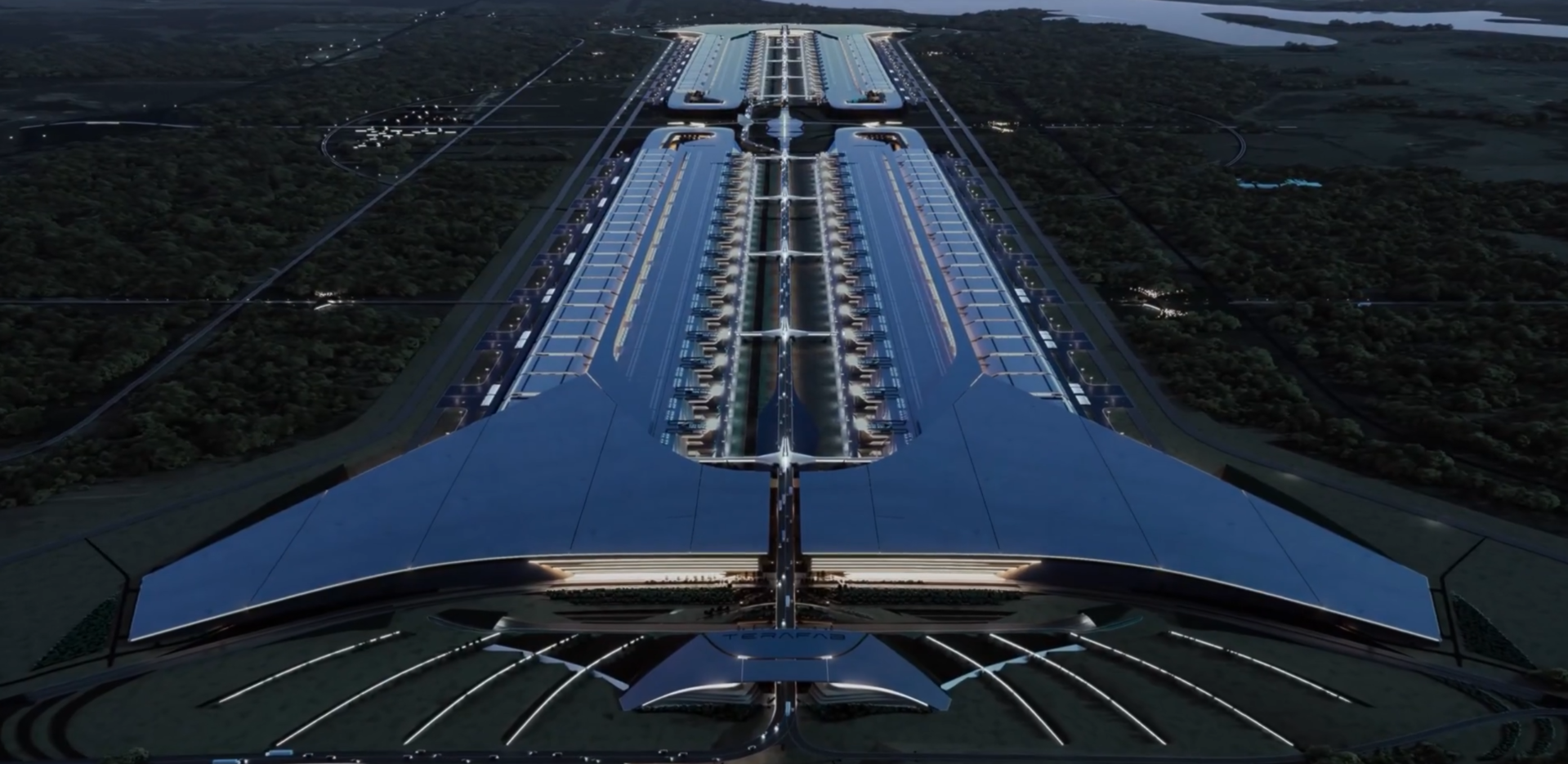
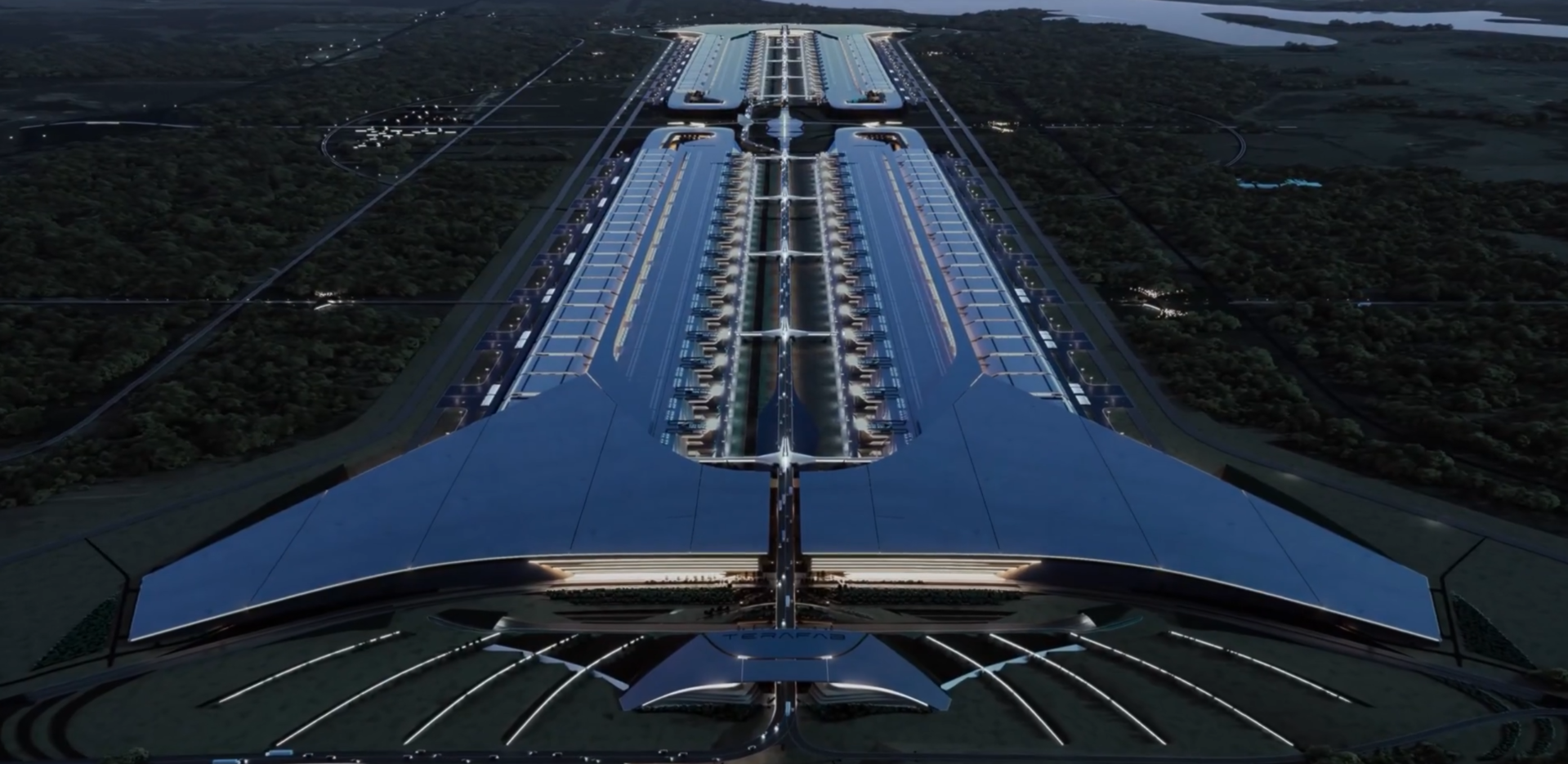
A render of the Terafab, taken from a video shared on X by Elon Musk
The scale being claimed remains difficult to reconcile with anything the semiconductor industry has built before. A 100 million square foot footprint is more than ten times the floor space of TSMC’s largest existing fabs, and TSMC is spending roughly US$165bn on six new fabs in Arizona that still occupy a fraction of Terafab’s stated size.
The “one terawatt of compute per year” figure Tesla and SpaceX have cited for the centre also does not correspond to any standard chip industry benchmark, tracing instead to Musk’s visions of orbital data centres and millions of Cybercabs roaming the world’s streets within a couple of years. Given how often his forward-looking statements have missed their original timelines, this figure is worth treating with particular caution.
Musk notably released a promotional render alongside the site confirmation showing Optimus robots and the long-delayed Robovan working the grounds, a vehicle which has not appeared in factory footage since its 2024 unveiling and still has no confirmed production timeline. Using it to dress up Terafab’s announcement suggests the confirmed site and signed tax agreements matter to Musk as much for sustaining interest in Tesla’s unproven product roadmap as for the fab itself.
The project, in that sense, carries the dimensions of expensive marketing. All Tesla and SpaceX have actually confirmed is a location and an initial dollar figure, and little else besides. Every other claim attached to Terafab—the scale that dwarfs anything the chip industry has built before, the terawatt of compute target with no precedent in semiconductor manufacturing, the vertical integration narrative that a struggling Intel Foundry now quietly underwrites—arguably leaves the project’s true scope more obscured than clarified.
Some of the use cases Terafab is being built to serve also raise questions that have not been fully answered—for example, how does one repair an orbital data centre when it breaks down? How does the Cybercab reach mass adoption when there is neither established trust in the safety of Tesla’s self-driving technology, nor a regulatory process that would allow it to be deployed in large numbers anywhere? A groundbreaking makes the project look real, but it does not offer definition or make it any more viable.
AP by OMG
Asian-Promotions.com |
Buy More, Pay Less | Anywhere in Asia
Shop Smarter on AP Today | FREE Product Samples, Latest
Discounts, Deals, Coupon Codes & Promotions | Direct Brand Updates every
second | Every Shopper’s Dream!
Asian-Promotions.com or AP lets you buy more and pay less
anywhere in Asia. Shop Smarter on AP Today. Sign-up for FREE Product Samples,
Latest Discounts, Deals, Coupon Codes & Promotions. With Direct Brand
Updates every second, AP is Every Shopper’s Dream come true! Stretch your
dollar now with AP. Start saving today!
Originally posted on: https://www.automotiveworld.com/news/tesla-puts-terafab-in-texas-for-us16bn-but-plan-still-vague/