Xiaomi’s 550k annual target now rests on Sky Nomad
Xiaomi’s automotive unit delivered 31,267 vehicles in July, up a modest 2.68% year-on-year but down almost 10% from June, according to China Passenger Car Association (CPCA) data released 12 August. The figure leaves the automotive newcomer at just 39% of its 550,000-unit annual target with only five months left on the clock—a gap that now looks vanishingly difficult to close through its existing two-model lineup alone.
The two models moved in opposite directions during the month. The SU7 sedan recovered to 21,044 units, up 3.09% from June and ending a two-month run of declines, although it remained down 13.79% year-on-year against a stronger year-ago base. The YU7 SUV, on the other hand, fell 28.63% month-on-month to just 10,223 units, extending a pattern in which Xiaomi’s newer model has now trailed Tesla’s Model Y in every month since January.
The SU7 is only several months removed from a model update. Launched on 19 March 2026 with deliveries commencing just four days later, the update directly addresses tightening Chinese regulatory standards. It introduced mechanical door-release mechanisms following crash concerns over electronic handles, while standardising LiDAR hazard detection following a fatal accident involving Xiaomi’s driver-assistance system. Beyond these compliance adjustments, the revised model features a reinforced ultra-high-strength steel safety cage and an upgraded electrical architecture for faster charging and extended range.
The updated SU7 generated a sharp uptick by locking in 15,000 non-refundable orders within 34 minutes and delivering over 7,000 units in its first nine days. Deliveries quickly stabilised above 24,000 units per month through the second quarter of 2026, driving Xiaomi’s total monthly deliveries back over the 30,000 threshold.
Tesla is arguably Xiaomi’s primary competitor—it should be noted that Tesla has several—but the sales divergence runs in both directions depending on the model. The SU7 outsold the Model 3 roughly ten to one in July—21,044 units against 2,091—aided partly by a structural quirk in Tesla’s Shanghai output, which compresses domestic retail volumes at the start of each quarter to prioritise export logistics. However, it did fall short of the Model Y’s 25,158 deliveries; the Model Y also outsold the YU7 by a factor of roughly 2.5 to one.
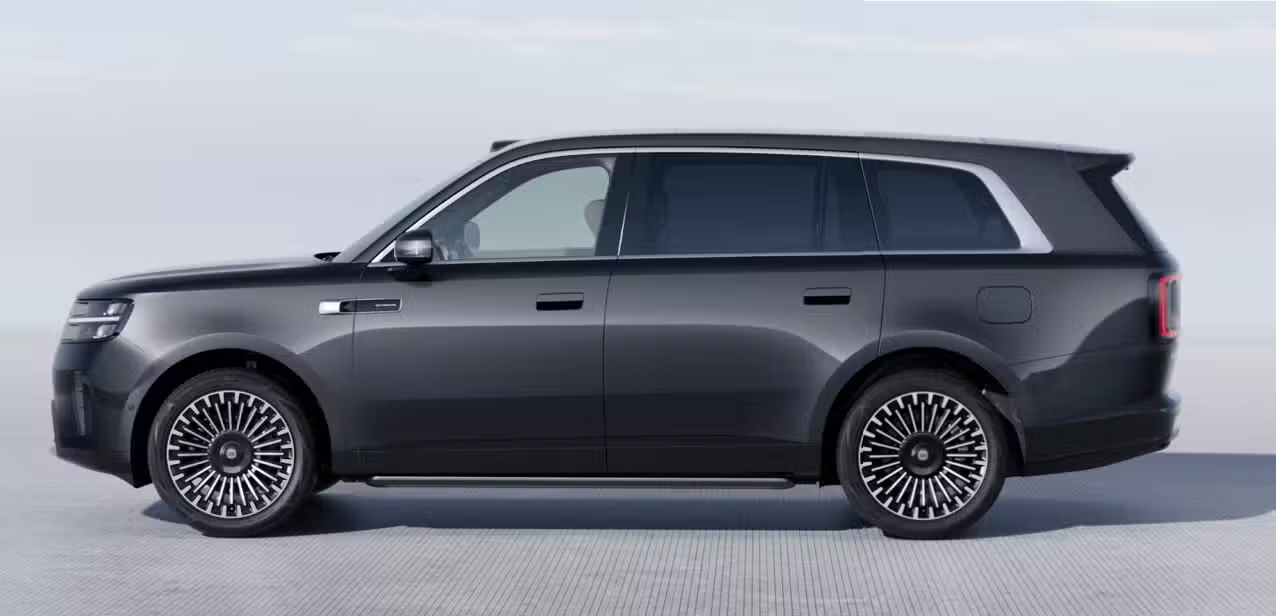
Xiaomi’s Sky Nomad EREVs will likely do much of the heavy lifting for its 2026 sales volumes
Reaching Xiaomi’s full-year target now requires average monthly deliveries of nearly 67,000 units for the rest of the year, more than double July’s pace and well above the 50,212 units the existing two-model lineup has ever managed in its best month. Closing that gap depends almost entirely on Sky Nomad, the extended-range electric vehicle series Xiaomi introduced on 30 July. Deliveries are scheduled to begin in September 2026.
Sky Nomad marks Xiaomi’s first move beyond pure battery-electric vehicles into the extended-range electric vehicle (EREV) segment, pairing a battery with a small internal combustion engine acting solely as a generator. The seven-seat N90 Max, priced from CN¥299,900 (US$44,500), and the five-seat N70, priced from CN¥259,900, both undercut Tesla’s China-built Model Y L at CN¥339,000 and are positioned directly against Li Auto and Huawei-backed Aito, which together account for seven of China’s ten best-selling extended-range SUVs.
Local news reports, not yet verified, have indicated that pre-orders may have already exceeded 100,000 units. But converting that demand into deliveries within the time remaining presents its own challenge. Sky Nomad deliveries are not scheduled to begin until September, leaving only four months to contribute toward the annual target, and Xiaomi’s Beijing plant only received regulatory clearance to build extended-range vehicles in June.
Hitting the full-year goal through Sky Nomad alone would require production rates approaching 75,000 vehicles a month, roughly one vehicle every 40 seconds around the clock. This is, in theory, possible, but it must be acknowledged that Xiaomi has a history of leaving its customers with wait times stretching north of a year during vehicle launch windows. It took the automaker almost a year to upgrade its production capacity such that YU7 wait times were back in the seven to ten-week range.
However, Sky Nomad’s relevance extends well beyond this year’s domestic delivery count. Xiaomi has been quietly building European infrastructure since opening a Munich research and design centre in 2025, and the EU’s tariffs on Chinese-made BEVs make EREVs a more logical lead vehicle for the automaker’s debut in European markets—particularly given their establishing aptitude for stopgap solutions over full electrification. Xiaomi has not yet articulated any plans for manufacturing outside of China.
Investors reacted to the pricing strategy with clear unease. Xiaomi’s Hong Kong-listed shares fell as much as 11% intraday on 31 July before closing down 7.28%, with Deutsche Bank analysts led by Wang Bin attributing the aggressive pricing to pressure on Xiaomi to boost volume rather than a confident margin position.
Having comfortably beaten its revised 2025 target, Xiaomi now faces a considerably harder test in 2026. Falling meaningfully short of 550,000 units would undermine the credibility the company has spent more than two years building through extensive local marketing and expensive Tesla and BMW alumni hires.
AP by OMG
Asian-Promotions.com |
Buy More, Pay Less | Anywhere in Asia
Shop Smarter on AP Today | FREE Product Samples, Latest
Discounts, Deals, Coupon Codes & Promotions | Direct Brand Updates every
second | Every Shopper’s Dream!
Asian-Promotions.com or AP lets you buy more and pay less
anywhere in Asia. Shop Smarter on AP Today. Sign-up for FREE Product Samples,
Latest Discounts, Deals, Coupon Codes & Promotions. With Direct Brand
Updates every second, AP is Every Shopper’s Dream come true! Stretch your
dollar now with AP. Start saving today!
Originally posted on: https://www.automotiveworld.com/news/xiaomis-550k-annual-target-now-rests-on-sky-nomad/